
The Gāyatrī Mantra, Word by Word
What it says, how to say it, where it comes from — and how it has been handed on.
The Gāyatrī mantra is a single verse of the Ṛgveda, sung at sunrise for some three thousand years. People have spent whole lifetimes inside its ten words, and no page holds the bottom of it — this one included. But the words can be opened simply, one at a time, and even opened simply they ask for something surprising.
Not wealth. Not safety. Not long life. The verse asks for a spark — for the light that moves everything to touch the place a life moves from. It is a hymn for the fire that practice burns on.
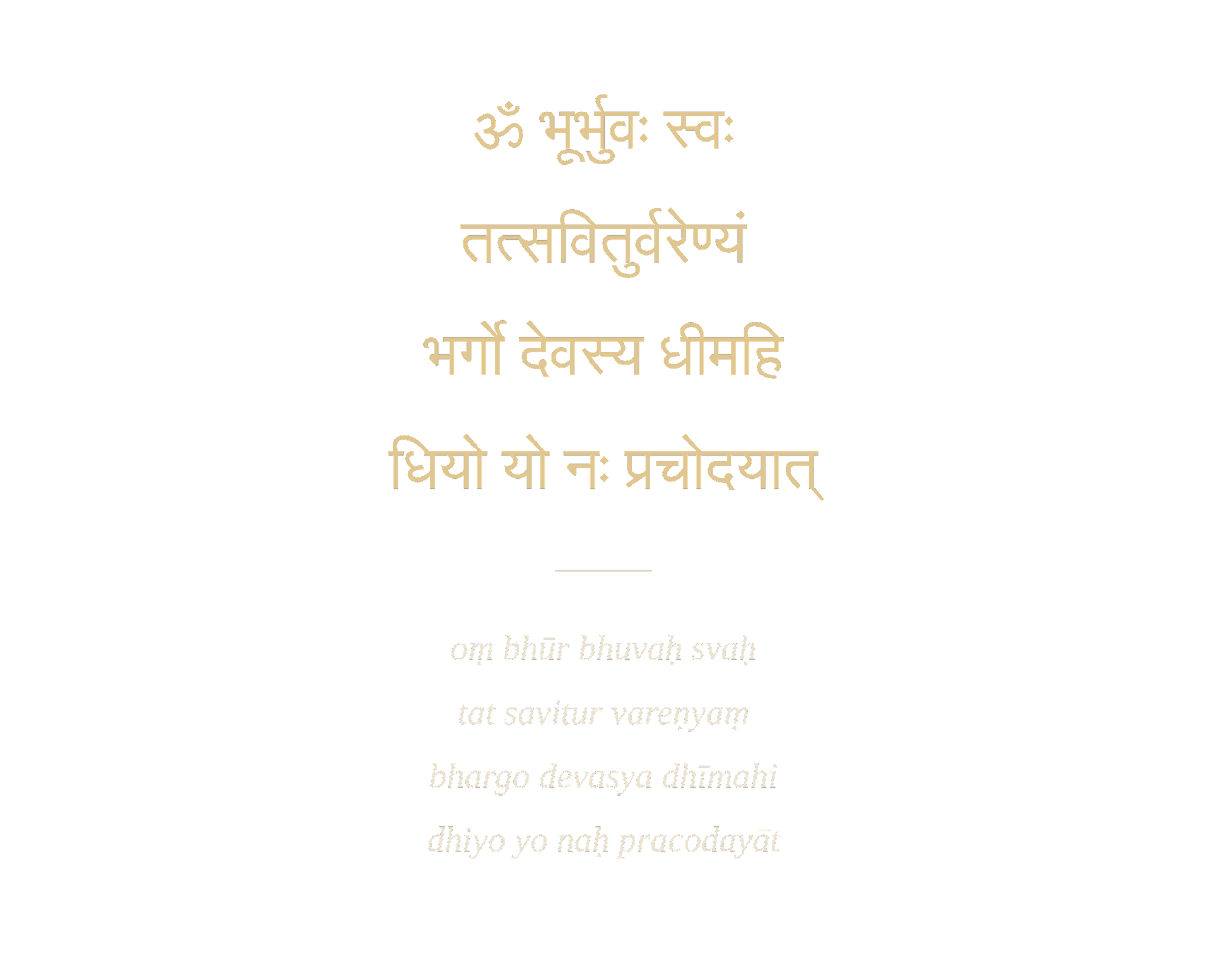
The Gayatri mantra in Devanagari and transliteration — Rigveda 3.62.10
The words, one at a time:
oṃ. The first seed. The sound the old ones say all the others come from — found by the sages who sat still long enough to hear what was already there. Many chants begin with it. This one does.
bhūr bhuvaḥ svaḥ. Earth, air, heaven. The three worlds, named in one breath before the verse begins. The verse came first — these were raised at its edge later, the way an arch is raised at the entrance of a garden already growing. You pass under them on the way in. And chanted, they are not small: below, the deep ground of everything. In the middle, the softness of the human heart. Above, the fire of awakening. By the time the verse begins, nothing has been left out. Some chant seven worlds here instead of three, gathering every level there is — and either way the power is not in the invocation. It is in the practice, the slow aligning with what the words reveal inside.
tat. That. The pointing word — and, in the old teachings, the largest word in the language. What is beyond every name cannot be named; it can only be pointed toward. So the pointing word itself became a name of the unnameable — the imperishable, the essence of existence. Tat tvam asi, an Upaniṣad says: that, you are. And in this verse the pointing is not abstract — tat points a few words ahead, to a radiance the verse has not named yet. Hold the pointing. It will be answered.
savitur. Of Savitṛ — the sun, not as the disk in the sky but as the one who stirs everything awake. The name comes from a root that means to set in motion. Not light as something to look at. Light as will — the impulse that starts the day, the seed, the practice.
vareṇyaṃ. Worthy of being chosen. The thing you would pick above everything else, if the choosing were yours.
bhargo. Radiance. Not the light that falls on things — the light things shine with.
devasya. Of the shining one. Deva comes from a root that means to shine; the word for the Divine and the word for light were never two words.
dhīmahi. May we hold it. The old word underneath — dhī — is not thought the way we use the word now, the mind talking to itself. It is the inner seeing. Intent. The aim a life bends around. And notice: we. The verse is never sung alone, even when only one person is singing it.
dhiyo. Those inner seeings — the intents, the purposes. The deepest longing in a person, the place a life moves from.
yo. Who.
naḥ. Our.
pracodayāt. May he kindle them. May he set them moving. The last word of the verse is the whole request: not gifts, not rescue — that the deepest intent in us be lit, and lit again, the way a fire is tended.
Put back together: We hold in our innermost seeing the chosen radiance of Savitṛ, the one who sets all things in motion — may he kindle that seeing in us.
How do you pronounce the Gāyatrī mantra?
Slowly. The long vowels are held — Gā-ya-trī, the first and last syllables given twice the time. The lines want an even, walking pace; the mantra was made to be sung, not said. If the marks above and below the letters are new to you, they are a small language of their own, and a friendly one — [how to say Siṃhī and the names in the series → ] walks through them gently.
And if the sounds come out awkward in your mouth at first, they are in good company. I chanted mantras for years before I heard, in a single flash, that I had been saying one of them wrong the whole time. Catching the sound underneath a word is the work of a lifetime — not a gate you pass through before you are allowed to begin.
The old tradition guarded these sounds closely, but it guarded them by ear — over years, with a teacher beside the student, correcting as they went. Starting wrong was not a failure of the method. It was the method. What shifted later, when the texts were first studied from the outside and on the page, was the order — meaning first, sound as a technicality to get right. The old order was the other way around. Find the sound, and the meaning unfolds from inside it.
Where does the Gāyatrī mantra come from?
It is Ṛgveda 3.62.10 — a verse of the oldest collection of poetry in the language, the oldest song still being sung. The Ṛgveda's very first word is agním — fire. The whole collection opens on fire, and this verse, deep inside it, asks for a share of that fire where it matters most: inside.
Gāyatrī is first the name of the meter — three lines of eight syllables, the shape a hymn takes when it is sung. The verse was so loved that it came to be called by the shape it is sung in, and the shape became a name, and the name became — in the old stories — a goddess, the mother of the Vedas. A verse, a meter, a song, a mother. The tradition does not treat these as four things.
How it was handed on
Not the way a lesson is handed on. There was no class, no test, no getting it right. The verse moved the way songs move: from mother to daughter, father to son, teacher to student — sung over someone long before they could understand it, often before they could speak. The understanding came later, sometimes much later, and when it came it arrived the way recognition arrives: oh. That is what I have been saying all this time.
It still moves that way. My children have picked up this verse — and hymns far longer than this one — just from hearing me sing them. Nobody sat them down. The body is the first listener.
A translation, this one included, can point at the words. The handing-on is the part no translation carries.
There is a book in this series where the mantra travels that way — not explained, but sung. A father gives his daughter the forty-six sounds her mother sang in, each one felt in the body before it is ever named. The Gāyatrī gives that book its title, and her name to the mother at the heart of the whole series.
Meet Gāyatrī's Song: The Receiving →
Begin where you are.
Some mornings want a song. Some want a room. There is one of those too — an hour of lying down and going inside, in Ashland or online.
Sessions are sixty dollars.
About the sessions