

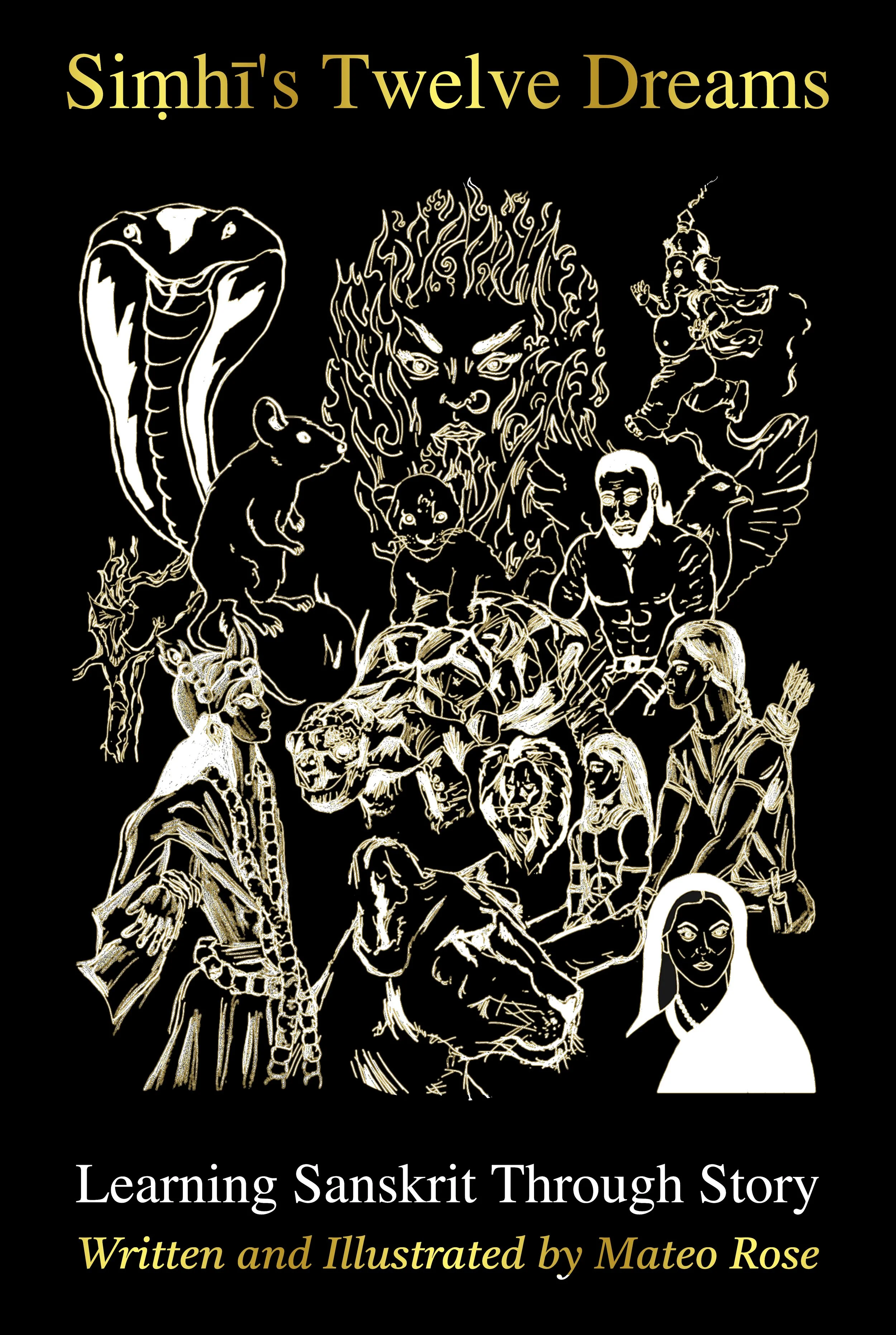
Siṃhī's Twelve Dreams: Learning Sanskrit Through Story
Some books teach you a language.
This one lets you dream in it.
✦ ✦ ✦
She has the sounds. Now the language comes up to meet her.
In Gāyatrī's Song, a young lioness sat beneath an ancient tree for three nights and received the whole of the Sanskrit alphabet from her father — every sound, the eight cases, her first complete sentence drawn into the earth by his paw. Siṃhī's Twelve Dreams is what came after: twelve more nights, and in each one a dream, and in each dream a visitor who arrives carrying a word she has not yet been given.
But this is also another book, running beneath the first. While the cub sleeps, far to the north, at the bottom of the world, two old ones sit at a fire — a snake and a tortoise, the oldest of witnesses — and the tortoise tells the story of her mother's life. All of it. From a young lioness singing alone in the tall grass to the storm that took her. The cub does not hear this telling. She is dreaming. What she dreams, night by night, are the faces out of the very stories she is being told — and she will not know this until the last morning, when the snake sees it whole: We have been telling one thing from two ends. The night her mother died and the night her daughter woke into language are the same night.
That is what this book is for. The Sanskrit teaching lives inside the dream. As each word arrives, her father gives it to her — what it means, the garment it wears, sometimes a small story of where it comes from. Nothing is set apart in tables; each word is taught where it is met. Devanāgarī, the IAST marks, and the English sit side by side, a few sentences at a time. The first dream asks almost nothing of you — siṃhī āsīt, Siṃhī was — and by the twelfth you are reading compound words, participles, and full conversations. Nothing is given that has not been prepared.
Read each sentence aloud before you read its meaning. The body of the language is its sound. The carrying is the first fluency.
For anyone who has the alphabet and is ready for the sentence. For adult learners coming to Sanskrit through yoga, meditation, or study. For readers who want their first sentences to arrive the way the cub's did — inside a story, before they are explained.
Release: September 10th, 2026