The Boy in the Cave
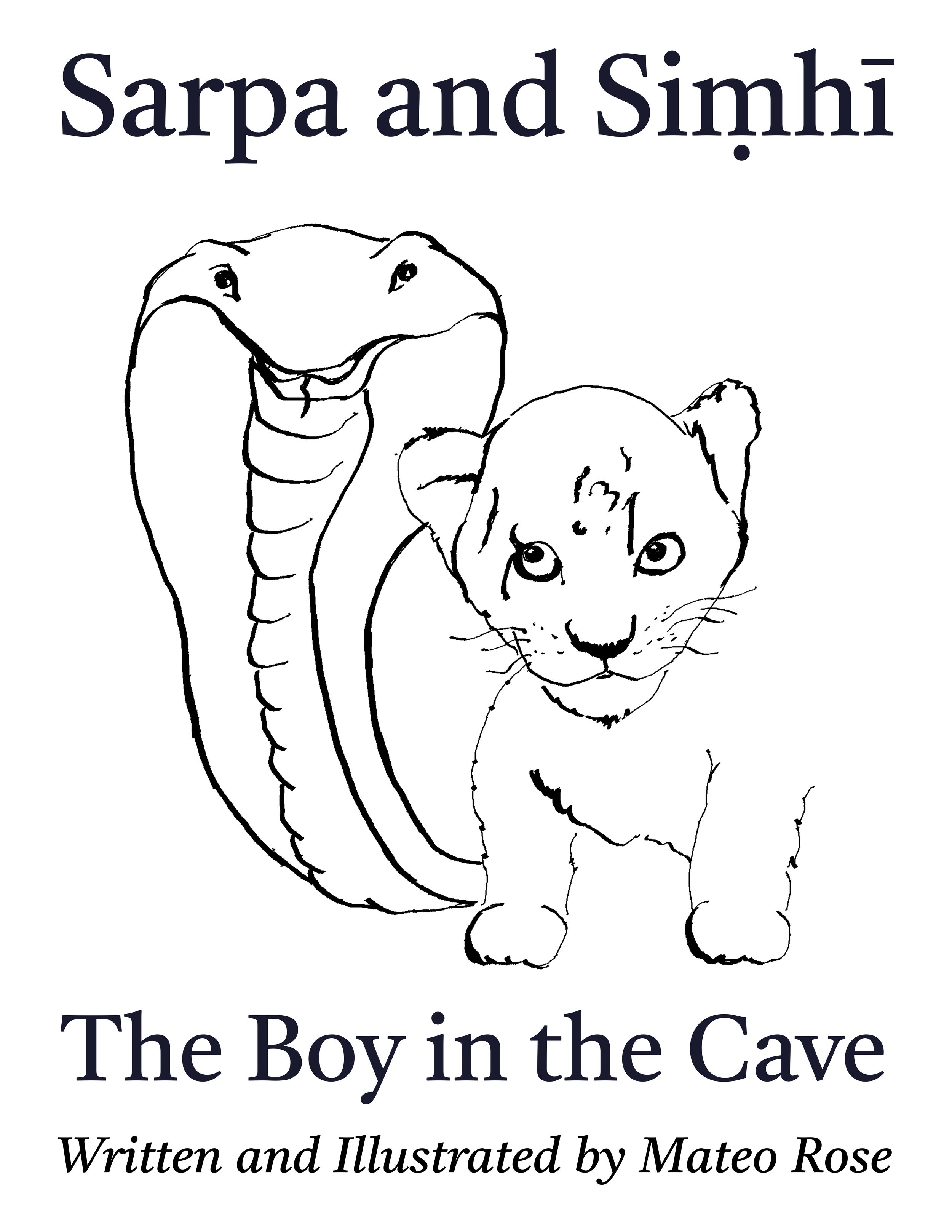
A young lioness loses her mother in a storm. A wise serpent tells her stories in a cave. And in the space between grief and courage, you learn Sanskrit.
Sarpa and Siṃhī is a story that teaches. Written in the Hitopadeśa style — accessible Classical Sanskrit prose, the language of the old fable tradition — this illustrated Sanskrit reader follows a young lioness through loss, fear, and the slow kindling of wisdom, while introducing readers to the beauty and structure of the language through a story built to carry it.
Each sentence is presented in three lines — Devanāgarī script, IAST transliteration, and English translation — accompanied by detailed vocabulary notes, sandhi analysis, and grammatical commentary. For students ready to move from grammar to reading, whether through self-study, university coursework, or personal practice.
✦ ✦ ✦
Inside this book:
Three interconnected stories — The Boy in the Cave, The Seed and the Sun, and the frame narrative of Sarpa and Siṃhī — each exploring a different dimension of the concluding śloka.
Grammar through story: existence sentences, imperfect narrative, bahuvrīhi and tatpuruṣa compounds, locative absolutes, absolutive chains, and the sustained iti speech frame.
A comprehensive vocabulary — drawn from the Hitopadeśa corpus and opening toward the wider tradition — organized both by order of appearance and in traditional varṇamālā order. A reference glossary designed to serve readers through the full series.
Complete sandhi analysis at every junction, building intuitive pattern recognition.
Original illustrations accompanying each section of the narrative.
A concluding śloka that gathers every thread: Wisdom transforms darkness to light, grief to love, fear to courage — and forever leads us back home.
✦ ✦ ✦
About The Siṃhī Reader Series
The Siṃhī Reader Series is the Sanskrit edition of Siṃhī: The Becoming — offered book by book as the voice in which the young lioness, now grown, begins to tell the story to her own daughter.
Each book of the series is a literary translation into Sanskrit, composed within the attested tradition. Book 1 draws from the Hitopadeśa and holds steadily to that register. As the series continues, the language modulates to meet each book's material — drawing on the Mahābhārata, Rāmāyaṇa, Yoga Sūtra, Ṛg Veda, Devī Māhātmya, Upaniṣads, and Bhagavad Gītā as their source texts appear. Where an attested word or construction exists, it is used. Where one does not, paraphrase stays within the corpus. Nothing is invented.
The series is intended for students of classical Sanskrit — from intermediate readers ready for sustained prose, through advanced readers meeting the later, more densely drawn books.
Book 1 is forthcoming in 2026. Subsequent books will follow as they are completed.